Symmetrical triangles are usually continuation patterns with converging trend lines. The technical buy point from a symmetrical triangle is the upside break, while a downside break is a technical sell signal. Ideally, a stock breaks out from a symmetrical triangle prior to reaching the apex of the triangle with volume expansion.
Context: Found within a trend, the symmetrical triangle forms as a consolidation period within the trend.
Appearance: The trend is well-established, and the formation of the symmetrical triangle is a resting phase for the stock. Trend lines can be drawn connecting the reaction lows and highs of the resting phase, which should reveal converging price action with symmetry. Volume contracts during the consolidation. A breakout should occur somewhere between 50-75% into the triangle pattern. An early or late breakout is more prone to failure, and therefore a less reliable breakout. Price may find the apex to be support or resistance following a breakout, so a successful test of the triangle adds reliability to this pattern.
Breakout Expectation: The widest portion of the triangle may be measured and added to the breakout point (or subtracted in the case of a downtrend) to determine the expected price move which follows. A trend line can be drawn parallel to the trend line which slopes in the direction of the breakout, with the extension being used as a target for the move.
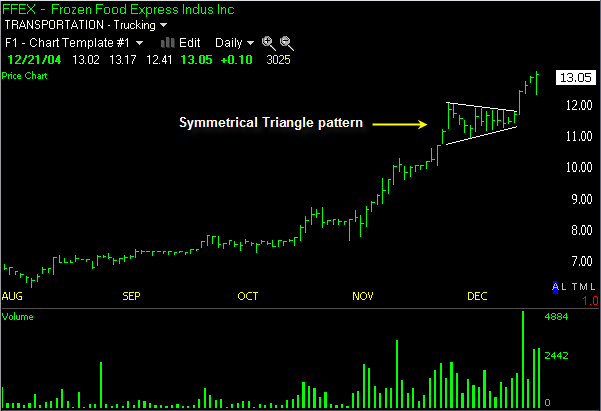
This stock formed a symmetrical triangle pattern during its uptrend which led to upside continuation. The buy point is when price clears the upper trend line and volume expands to take the stock higher.
Symmetrical triangle patterns provide opportunities for trades which offer both well-defined entries and exits, so we like to point these out for members of our stock pick service. Come trade with us!
Be sure to learn more about triangle patterns such as the ascending triangle pattern and the descending triangle pattern.